The Lord Is My Shepherd: What Sheep and Shepherds Reveal About Scripture
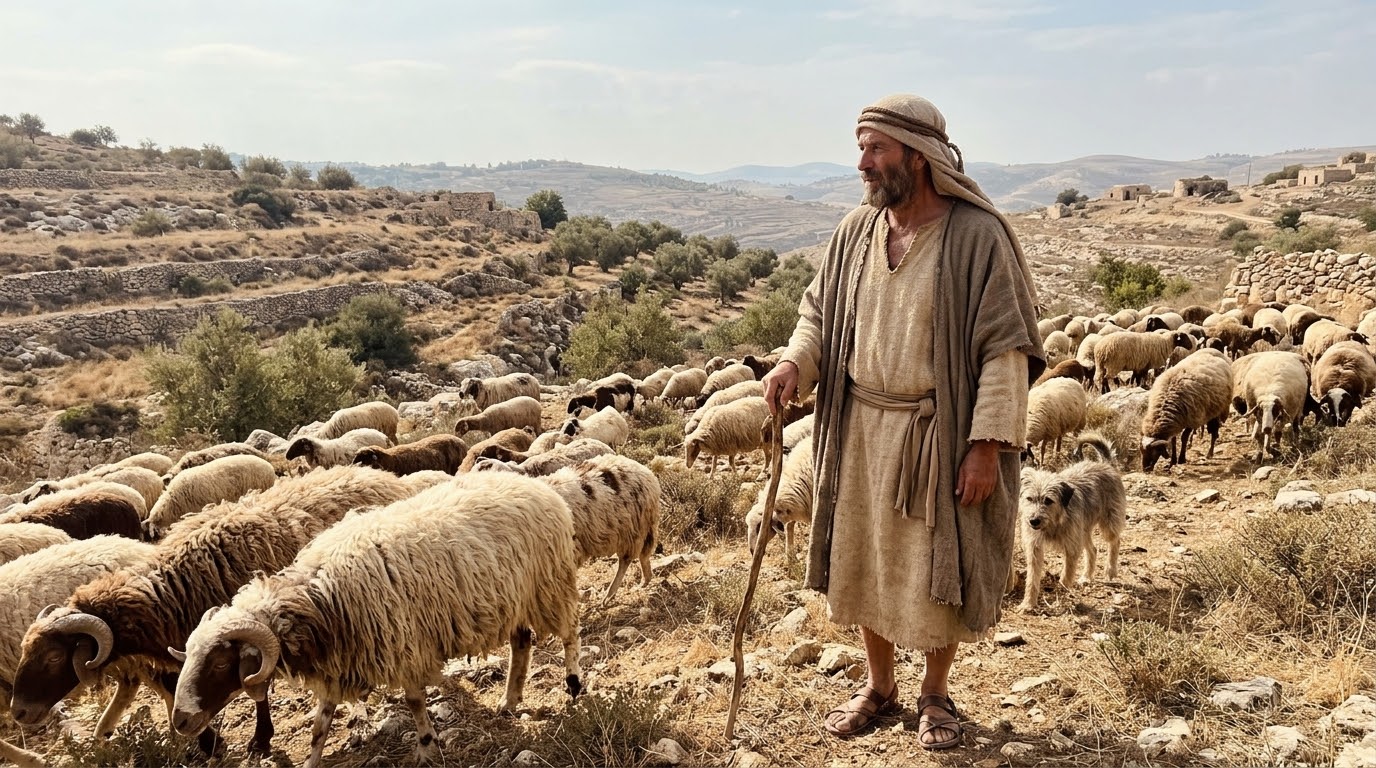
Of all the animals God could have used to describe His people, He kept coming back to one. Sheep run through the whole Bible, from Abel, who "was a keeper of sheep" (Genesis 4:2), to John's vision of heaven, where he says, "I saw a Lamb standing, as though it had been slain" (Revelation 5:6). The first people to hear these words didn't need any of it explained. They had carried newborn lambs inside on cold nights, drawn water for thirsty flocks, and lain awake listening for wolves.
Most of us have never touched a sheep. So when we read "The LORD is my shepherd; I shall not want" (Psalm 23:1), it lands softly, like a line on a sympathy card. An Israelite heard something much sharper. The Hebrew word for shepherd, ra'ah, is a verb before it is a title: it means to tend, to feed, to graze a flock. To call God your ra'ah was to say your next meal, your next drink of water, and your survival through the night all depended on Him actually doing the work.
Once you understand how sheep think and how shepherds lived, dozens of familiar verses come alive. Let's walk out into the field.
The Shepherd's World
Israel's story is, in a real sense, a shepherd's story. Its founding fathers were herdsmen: "Abram was very rich in livestock, in silver, and in gold" (Genesis 13:2), and Jacob "increased greatly and had large flocks" (Genesis 30:43). The work belonged to the whole family. When Jacob first met the woman he would marry, "Rachel came with her father's sheep, for she was a shepherdess" (Genesis 29:9).
God kept choosing His leaders from the pasture. Moses spent forty years in the wilderness before his calling, and the burning bush found him at work: "Now Moses was keeping the flock of his father-in-law, Jethro, the priest of Midian, and he led his flock to the west side of the wilderness" (Exodus 3:1). Israel's greatest king started the same way. God "chose David his servant and took him from the sheepfolds; from following the nursing ewes he brought him to shepherd Jacob his people" (Psalm 78:70–71). Even the prophet Amos protested, "I was a herdsman and a dresser of sycamore figs. But the LORD took me from following the flock" (Amos 7:14–15).
The land itself shaped the job. Much of Judea is dry, rocky hill country where grass grows thin and only in season. Flocks never stayed put for long. They moved to lower ground in the rainy winter, up into the hills and onto harvested fields in summer. A shepherd's day began before sunrise and ended after dark: lead them out, find grass, find water, watch for lions and thieves, bring everyone home, and count them.
Shepherds were not always respected for it. Joseph warned his brothers that in Egypt "every shepherd is an abomination to the Egyptians" (Genesis 46:34). By the first century, according to scholar Joachim Jeremias, hired shepherds were widely distrusted; Randy Alcorn summarizes that view as shepherds being seen as second-class and untrustworthy. Some scholars think that picture leans too heavily on later rabbinic writings, so it's best taken as one strand of the evidence.
Either way, look at who heard the news first on the night Jesus was born: "And in the same region there were shepherds out in the field, keeping watch over their flock by night" (Luke 2:8). Not priests. Not kings. Working men on the night shift. The Lamb of God was first announced to the men who raised lambs.
Not Dumb, Just Dependent
You've probably heard a preacher say God calls us sheep because sheep are stupid. It gets a laugh, but it isn't true, and it misses the point Scripture is actually making.
The "dumb sheep" reputation comes from two behaviors. The first is the flocking reflex: under stress, sheep bunch tightly and stampede together, even in the wrong direction. The second is what scientists call tonic immobility. A sheep that is cornered or flipped over often freezes instead of fighting back. To us, that looks like foolish passivity. In the wild, it's survival. A sheep that breaks from the herd, or tries to fight a wolf, dies. Staying with the group and going still are the best tools an animal with no weapons has.
Meanwhile, the research on sheep cognition is surprising. In a 2001 study published in Nature, Keith Kendrick's team at the Babraham Institute found that sheep can remember 50 different sheep faces for more than two years, along with about ten human faces. Follow-up work found they can read emotion in faces and prefer calm, happy expressions over angry ones. Sheep in these studies learned and retained maze routes, and in 2011 Cambridge researchers showed they can do reversal learning and attentional set-shifting, adapting when the rules of a task change, in what the authors described as executive tasks previously seen mainly in primates. Sheep even appear to doctor themselves. Utah State University studies found that lambs carrying intestinal worms chose more tannin-rich feed, a natural anti-parasite, and cut back once the parasites cleared.
So the biblical comparison isn't "you are dim-witted." It's something humbler and truer: you are a creature made to live close to a shepherd, and the moment you aren't, you're in danger. Jesus said it plainly: "I am the good shepherd. I know my own and my own know me" (John 10:14). Sheep are wired to know who they belong to. So are we.
How a Sheep Lives, and What It Teaches
Watch a flock for a day and you start seeing Scripture everywhere.
Start with how sheep navigate. Their eyes sit on the sides of their heads, giving them a huge field of view but poor depth perception, so they lean heavily on their highly developed senses, especially hearing. They learn the exact voice, cadence and whistle of their own shepherd and bolt from a stranger's. That is the world Jesus was describing when He said, "My sheep hear my voice, and I know them, and they follow me" (John 10:27). Notice that He didn't say "my sheep see me." Biblical faith works the same way: "So faith comes from hearing, and hearing through the word of Christ" (Romans 10:17). We follow a voice we've learned to trust, often before we can see where the path goes.
Then there's how sheep graze: heads down, nibbling the patch of grass right in front of them. A sheep doesn't plan to get lost. It just takes one more step toward the next good bite, then another, until it looks up and the flock is gone. Isaiah captured this perfectly: "All we like sheep have gone astray; we have turned—every one—to his own way; and the LORD has laid on him the iniquity of us all" (Isaiah 53:6). The Hebrew verb for "gone astray," ta'ah, means to wander, stray or stagger. The law uses it for a lost animal ("If you meet your enemy's ox or his donkey going astray," Exodus 23:4), and Isaiah uses it for drunks who stagger (Isaiah 28:7). It's not a picture of calculated rebellion so much as drift: appetite and distraction, one step at a time. And the remedy is in the same verse. "Laid on him" translates paga, to meet or fall upon. Our scattered wandering all converges on one Person.
Sheep also hate being alone. A lone sheep's heart rate and stress hormones spike quickly, and animal-handling experts note that an isolated sheep feels exposed and vulnerable and will try desperately to get back in sight of the others. Predators know this. A wolf doesn't charge into the middle of a guarded flock; it shadows the edges and waits for a straggler. Peter wrote with that picture in mind: "Be sober-minded; be watchful. Your adversary the devil prowls around like a roaring lion, seeking someone to devour" (1 Peter 5:8). That's also why Scripture won't let us go it alone: "not neglecting to meet together, as is the habit of some" (Hebrews 10:25).
This is what moved Jesus: "When he saw the crowds, he had compassion for them, because they were harassed and helpless, like sheep without a shepherd" (Matthew 9:36). The Greek is even more vivid. Eskulmenoi ("harassed") can mean mauled or even flayed. Errimmenoi ("helpless") literally means thrown down, lying where they fell. Jesus looked at people and saw sheep that had been mauled and left on the ground.
Finally, sheep have no offensive weapons. They don't bite, claw or ambush. When they are handled for shearing, they usually go quiet and still. Isaiah saw the Messiah in that silence: "He was oppressed, and he was afflicted, yet he opened not his mouth; like a lamb that is led to the slaughter, and like a sheep that before its shearers is silent, so he opened not his mouth" (Isaiah 53:7). The Hebrew for "silent," ne'elamah, comes from a root meaning to be bound or tongue-tied. The Gospels record exactly that silence before His accusers: "he gave him no answer, not even to a single charge, so that the governor was greatly amazed" (Matthew 27:14). And Jesus sends His followers out with the same vulnerability: "Behold, I am sending you out as sheep in the midst of wolves, so be wise as serpents and innocent as doves" (Matthew 10:16). We aren't sent with claws. We're sent with a Shepherd.
Psalm 23 Through a Shepherd's Eyes
David didn't write Psalm 23 from a library. He wrote it as a man who had chased lions off his father's flock. Read slowly, every line names a real part of the job.
"The LORD is my shepherd; I shall not want." (Psalm 23:1)
The Hebrew chaser, "want," means to lack or be short of something. A sheep's whole condition depends on who owns it. Under a lazy owner, it goes hungry, gets sick and gets lost. Under a good one, it lacks nothing it needs. David's whole psalm is a description of the second kind of owner.
"He makes me lie down in green pastures. He leads me beside still waters." (Psalm 23:2)
The phrase "makes me lie down" comes from rabats, the word for an animal stretching out to rest. Sheep won't do that while they're hungry, frightened or being pestered, so a resting sheep is a sheep whose needs have been met. But don't picture a lush Pennsylvania pasture. The Hebrew ne'ot deshe means "pastures of tender grass," and in the Judean wilderness that often meant sparse tufts of grass scattered across the hills, as Bible teacher Ray Vander Laan learned from shepherds there. The shepherd led the flock from patch to patch. It was enough for today, the same promise Jesus taught us to pray: "Give us this day our daily bread" (Matthew 6:11).
"Still waters" are, literally, mê menuchot, "waters of rests." Sheep shy away from fast water, and the wilderness wadis can flood violently after a storm. "Leads" is nahal, a verb used for guiding a flock gently to a watering place. The shepherd finds water a sheep can actually drink from without being swept away.
"He restores my soul. He leads me in paths of righteousness for his name's sake." (Psalm 23:3)
"Restores" is yeshobeb, from shuv, to turn back, return or bring back. "Soul" is nephesh, which originally meant throat or breath and came to mean the whole living self. David is saying, "He brings my life back."
Shepherds have a vivid picture for this: the "cast" sheep. Phillip Keller, who ranched sheep for years, described a heavy or long-fleeced sheep that lies down in a hollow, shifts its weight, and rolls onto its back until its feet no longer touch the ground. It cannot right itself. Gas builds in its rumen, presses on its lungs and cuts off circulation to its legs, and within hours it can suffocate. Predators know a cast sheep when they see one. The shepherd has to find it, roll it back over, and hold it steady until the feeling returns to its legs.
David uses similar language about his own heart: "Why are you cast down, O my soul, and why are you in turmoil within me? Hope in God; for I shall again praise him, my salvation" (Psalm 42:5). It's worth being precise here. "Cast" as a shepherd's term is English (from an old Norse word for "throw"). David's Hebrew word is shachach, which means to be bowed down, sunk low, crouched to the ground. The two words aren't related, but the picture is the same: a life knocked flat that can't get up on its own. Keller's examples come from modern ranching, so treat them as illustration, but the image of a helpless sheep that must be lifted is ancient and true.
"Paths of righteousness" are ma'gelei tsedeq, literally "tracks of rightness": worn trails that actually lead somewhere safe. Hillside flocks cut narrow paths into the slopes, and a sheep on the wrong one ends at a cliff edge or a dead end. "For his name's sake" means the shepherd's own reputation is on the line. A good shepherd with a lost flock is a contradiction.
"Even though I walk through the valley of the shadow of death, I will fear no evil, for you are with me; your rod and your staff, they comfort me." (Psalm 23:4)
"The shadow of death" is one Hebrew word, tsalmavet, meaning deep darkness. The wadis of the Judean wilderness are steep, narrow and shaded, perfect for an ambush, and often the only route to the next pasture. Notice the shift: up to now David has said "he." In the dark valley, he starts saying "you." The shepherd is no longer out ahead; he's right beside the sheep.
And he's carrying two tools, which we often blur together. The "rod" is shevet and the "staff" is mish'enet, from sha'an, to lean on. They did opposite jobs:
- The rod (shevet) — a short, thick club, often with a knobbed or weighted end, carried facing outward toward predators and downward for inspection. Shepherds used it for striking wolves, lions and thieves; parting the fleece to check for wounds; and counting sheep as they passed under it. It pictures God's authority and power over every enemy, and His close inspection and total ownership of us.
- The staff (mish'enet) — a long, slender pole, often with a curved crook, carried facing inward toward the sheep and downward for support. Shepherds used it for tapping strays back on course; hooking a sheep out of a crevice or thicket; helping roll a cast sheep upright; and leaning on. It pictures God's restoring grace and guidance — gentle correction that pulls us back from self-destruction.
David knew the rod firsthand: "Your servant used to keep sheep for his father. And when there came a lion, or a bear, and took a lamb from the flock, I went after him and struck him and delivered it out of his mouth" (1 Samuel 17:34–35). The same word, shevet, is used for a king's scepter, as in "You shall break them with a rod of iron" (Psalm 2:9). The rod was also how a shepherd counted and claimed his animals: "every tenth animal of all that pass under the herdsman's staff, shall be holy to the LORD" (Leviticus 27:32; the ESV renders the Hebrew rod-word as "staff" here), and God promises His people, "I will make you pass under the rod, and I will bring you into the bond of the covenant" (Ezekiel 20:37).
Why do both bring comfort? Because one without the other fails. A rod alone would make the shepherd a terror to his own sheep. A staff alone would leave them defenseless when the wolf comes. A God who only corrects us and a God who only protects us would both be less than the Shepherd David knew.
"You prepare a table before me in the presence of my enemies; you anoint my head with oil; my cup overflows." (Psalm 23:5)
"Anoint" is dishanta, literally "you have made fat," an image of richness and abundance. Shepherds did rub oil on their sheep's heads to soothe scratches and keep away biting insects. Many interpreters also hear the psalm shifting here from a shepherd to a host welcoming an honored guest. Both pictures fit: the One who tends the flock also seats you at His table.
"Surely goodness and mercy shall follow me all the days of my life, and I shall dwell in the house of the LORD forever." (Psalm 23:6)
"Follow" is radaph, which almost always means to pursue or chase. In the Psalms it's usually enemies who do the chasing. Here, God's goodness and His hesed (covenant love, loyal mercy) are what hunt David down. The sheep spends the whole psalm being led. At the end, it finds out it's also being pursued.
The Voice, the Fold and the Door (John 10)
John 10 can feel like Jesus is mixing His metaphors. First He's the shepherd, then He's the door, then He's the shepherd again. It all makes sense once you know where sheep slept at night.
Near a village, several families might share one walled pen with a single gate and a hired gatekeeper. Out in open country, a shepherd made do with a rough ring of stones or a cave. Commentators describe these folds as stone walls with one opening, often topped with thorny branches to keep out predators and thieves. Jesus starts with the village fold:
"Truly, truly, I say to you, he who does not enter the sheepfold by the door but climbs in by another way, that man is a thief and a robber. But he who enters by the door is the shepherd of the sheep. To him the gatekeeper opens. The sheep hear his voice, and he calls his own sheep by name and leads them out." (John 10:1–3)
When several flocks spent the night together, they mixed freely. In the morning, each shepherd stood outside and called. His own sheep lifted their heads, picked out his voice from the others, and came. Travelers in the region have long described a mingled crowd of sheep dividing into separate flocks, each falling in behind its own shepherd. Some shepherds really did name their sheep, often after a marking or a quirk. Put that next to what we know about sheep memory, and the next verses read almost like field notes:
"When he has brought out all his own, he goes before them, and the sheep follow him, for they know his voice. A stranger they will not follow, but they will flee from him, for they do not know the voice of strangers." (John 10:4–5)
Notice the shepherd "goes before them." Eastern shepherds generally led from the front instead of driving from behind. Leading means the shepherd meets the danger first.
Then Jesus moves out to the field fold, where there was no gate to swing shut. At night the shepherd lay down across the opening himself, so that nothing could get in or out without passing over him. His body was the door.
"I am the door. If anyone enters by me, he will be saved and will go in and out and find pasture." (John 10:9)
The only way to the flock is through the Shepherd. The only way out to pasture is through Him too. And a wolf that wants the sheep has to go through Him first.
That sets up the contrast Jesus draws next:
"I am the good shepherd. The good shepherd lays down his life for the sheep. He who is a hired hand and not a shepherd, who does not own the sheep, sees the wolf coming and leaves the sheep and flees, and the wolf snatches them and scatters them." (John 10:11–12)
The Greek word for "good" here is kalos, not the more common agathos. Kalos carries the sense of noble, beautiful, excellent: the shepherd who is everything a shepherd should be. And notice the hired hand isn't a villain. He's acting rationally. The sheep aren't his, so why die for them? Jesus' claim is the opposite of rational self-interest, and He insists it's His choice: "No one takes it from me, but I lay it down of my own accord" (John 10:18).
He even widens the fold: "And I have other sheep that are not of this fold. I must bring them also, and they will listen to my voice. So there will be one flock, one shepherd" (John 10:16). Every Gentile believer reading this post is one of those other sheep.
The Lost Sheep and the Cost of Losing One
In Israel, a lost sheep wasn't just a sad day for the shepherd. He could be held responsible for it. The law spelled out what a man owed when he was keeping someone else's animals:
"If a man gives to his neighbor a donkey or an ox or a sheep or any beast to keep safe, and it dies or is injured or is driven away, without anyone seeing it... But if it is stolen from him, he shall make restitution to its owner. If it is torn by beasts, let him bring it as evidence. He shall not make restitution for what has been torn." (Exodus 22:10, 12–13)
In other words, if a wild animal killed one, the shepherd had to bring back proof. Amos turns that grim practice into a warning for Israel: "As the shepherd rescues from the mouth of the lion two legs, or a piece of an ear, so shall the people of Israel who dwell in Samaria be rescued" (Amos 3:12). Picture a shepherd prying a scrap of ear out of a lion's jaws just to show the owner what happened.
Jacob went further than the law required. After twenty years tending his father-in-law's flocks, he told Laban: "What was torn by wild beasts I did not bring to you. I bore the loss of it myself. From my hand you required it, whether stolen by day or stolen by night. There I was: by day the heat consumed me, and the cold by night, and my sleep fled from my eyes" (Genesis 31:39–40). That's the real job: heat, cold, no sleep, and paying for every loss out of your own pocket.
Now listen to Jesus with that in your ears:
"What man of you, having a hundred sheep, if he has lost one of them, does not leave the ninety-nine in the open country, and go after the one that is lost, until he finds it? And when he has found it, he lays it on his shoulders, rejoicing. And when he comes home, he calls together his friends and his neighbors, saying to them, 'Rejoice with me, for I have found my sheep that was lost.'" (Luke 15:4–6)
A hundred sheep was a sizable flock, probably more than one man watched alone, so leaving the ninety-nine "in the open country" didn't mean abandoning them. Commentators note the lead shepherd would leave the rest with other hands while he searched.
Why does he carry it home on his shoulders? Remember what a frightened, isolated sheep does: it panics, then often lies down and freezes. A lost sheep frequently won't walk. So the shepherd hoists a full-grown animal across his neck and hikes it back over rough country. Jesus says he does it "rejoicing."
There's one more detail. Kenneth Bailey, who spent decades teaching in the Middle East, points out that Jesus says "if he has lost one of them": the shepherd lost it. Bailey connects the parable to Psalm 23, Jeremiah 23 and Ezekiel 34, where God condemns leaders who let His flock scatter and promises to go find them Himself. Jesus was telling it to Pharisees and scribes who complained that He ate with sinners. The point was sharp: "I'm doing what God said He would do, and what you should have been doing." He closes with, "Just so, I tell you, there will be more joy in heaven over one sinner who repents than over ninety-nine righteous persons who need no repentance" (Luke 15:7).
It's the same cry the psalmist prayed centuries earlier: "I have gone astray like a lost sheep; seek your servant, for I do not forget your commandments" (Psalm 119:176).
Sheep and Goats
Israelite flocks usually held both animals. The Hebrew word tson, often translated "flock," covers sheep and goats together. They grazed side by side all day, and from a distance they could be hard to tell apart; many Near Eastern sheep were dark-faced or brown, and many goats were the same size. But up close, they are very different creatures.
Sheep are grazers. They stay in the lower pastures, move at the shepherd's pace, and follow his lead. Goats are browsers and climbers. They are independent, curious and stubborn, scrambling up ledges a sheep would never try, stripping leaves off shrubs, and butting heads to settle who's in charge. Bible translators working with herding peoples today still hear the same thing: goats are harder to herd and less loved.
They also handle the cold differently. A sheep's dense, lanolin-rich wool lets it sleep in the open on a chilly night. A goat's thin coat doesn't. So at dusk, the shepherd sorted them. The United Bible Societies' translator's handbook explains that goats needed warmth at night while sheep preferred open air, and the IVP Bible Background Commentary adds that sheep were the more valuable animal. Every listener had watched this nightly sorting their whole lives. It was quick, routine and certain. Ezekiel had already used it as a picture of judgment: "As for you, my flock, thus says the Lord GOD: Behold, I judge between sheep and sheep, between rams and male goats" (Ezekiel 34:17).
Then Jesus used it for the end of history:
"When the Son of Man comes in his glory, and all the angels with him, then he will sit on his glorious throne. Before him will be gathered all the nations, and he will separate people one from another as a shepherd separates the sheep from the goats. And he will place the sheep on his right, but the goats on the left." (Matthew 25:31–33)
The Greek verb for "separate," aphorizo, means to mark off by a boundary, to set apart decisively. And then comes the surprise.
"For I was hungry and you gave me food, I was thirsty and you gave me drink, I was a stranger and you welcomed me, I was naked and you clothed me, I was sick and you visited me, I was in prison and you came to me." (Matthew 25:35–36)
The sheep have no idea what He's talking about: "Lord, when did we see you hungry and feed you, or thirsty and give you drink?" (Matthew 25:37). They weren't keeping score. Their compassion wasn't a calculated transaction to earn points with the King. It was a reflex, the natural behavior of people who live close to the Shepherd and close to the flock. "Truly, I say to you, as you did it to one of the least of these my brothers, you did it to me" (Matthew 25:40).
Now look at what the goats are condemned for. Not cruelty. Not violence. They didn't beat the poor or stone the prisoners. Their sin is omission:
"Then they also will answer, saying, 'Lord, when did we see you hungry or thirsty or a stranger or naked or sick or in prison, and did not minister to you?' Then he will answer them, saying, 'Truly, I say to you, as you did not do it to one of the least of these, you did not do it to me.'" (Matthew 25:44–45)
The goats are just as surprised as the sheep, but their question carries a different edge. It sounds like, "If we had known it was You, of course we would have helped." The people in front of them seemed to offer nothing: no status, no leverage, no reward. Self-sufficient and self-directed, like the animals they're named for, they simply walked past.
One more thing the pastoral picture makes clear: the evening sorting didn't turn goats into sheep. It just made public what each animal already was, the nature it had been living out in the field all day. Jesus is careful to say the sheep "inherit the kingdom prepared for you from the foundation of the world" (Matthew 25:34). Their deeds didn't make them His. They acted that way because they already were His.
The Lamb
The Bible's shepherd story doesn't end with a shepherd. It ends with a Lamb.
At the first Passover, every household chose a lamb and kept it close: "Your lamb shall be without blemish, a male a year old... and you shall keep it until the fourteenth day of this month, when the whole assembly of the congregation of Israel shall kill their lambs at twilight" (Exodus 12:5–6). Four days inside the house was long enough to check every inch of it for defects, and long enough for the children to get attached. Then its blood went on the doorposts: "When I see the blood, I will pass over you, and no plague will befall you to destroy you" (Exodus 12:13).
So when John the Baptist saw Jesus coming, every Jew within earshot knew exactly what he meant: "Behold, the Lamb of God, who takes away the sin of the world!" (John 1:29). Paul says it outright: "For Christ, our Passover lamb, has been sacrificed" (1 Corinthians 5:7). And Isaiah's silent sheep before the shearers, the one that "opened not his mouth," turns out to be the same Lamb.
Then Revelation does something beautiful. The slain Lamb, standing at the center of the throne, becomes the Shepherd: "For the Lamb in the midst of the throne will be their shepherd, and he will guide them to springs of living water, and God will wipe away every tear from their eyes" (Revelation 7:17). The Greek word behind "will be their shepherd" is poimanei, literally "he will shepherd them." The One who was led to the slaughter now leads His flock to the still waters of Psalm 23, forever.
Bad Shepherds and the Good Shepherd
In the ancient Near East, "shepherd" was a royal title. Kings from Mesopotamia to Egypt called themselves the shepherds of their people. When Israel's tribes crowned David, they reminded him what God had said: "You shall be shepherd of my people Israel, and you shall be prince over Israel" (2 Samuel 5:2). "Be shepherd" there is our word ra'ah again, to shepherd. So when the prophets thundered against "the shepherds," everyone knew they meant kings, priests and leaders.
Ezekiel's charge reads like a failed shepherd's job review, and every line lines up with the work we've been describing:
"Ah, shepherds of Israel who have been feeding yourselves! Should not shepherds feed the sheep? You eat the fat, you clothe yourselves with the wool, you slaughter the fat ones, but you do not feed the sheep. The weak you have not strengthened, the sick you have not healed, the injured you have not bound up, the strayed you have not brought back, the lost you have not sought, and with force and harshness you have ruled them. So they were scattered, because there was no shepherd, and they became food for all the wild beasts." (Ezekiel 34:2–5)
They used the rod and forgot the staff. They took the wool and left the wounds. And the scattered stragglers, exactly as we saw earlier, became food for predators.
God's answer is startlingly personal: "For thus says the Lord GOD: Behold, I, I myself will search for my sheep and will seek them out" (Ezekiel 34:11). Then He adds a promise that should have puzzled every reader: "And I will set up over them one shepherd, my servant David, and he shall feed them: he shall feed them and be their shepherd" (Ezekiel 34:23). David had been dead for roughly four hundred years. God was pointing to a coming Son of David who would be the shepherd Israel's kings never were. When Jesus said, "I am the good shepherd," He was claiming both halves of that promise: God Himself coming to search for His sheep, and David's Son ruling them.
Jeremiah says the same thing: "Woe to the shepherds who destroy and scatter the sheep of my pasture!" declares the LORD (Jeremiah 23:1), followed by the promise, "Behold, the days are coming, declares the LORD, when I will raise up for David a righteous Branch" (Jeremiah 23:5).
Zechariah even foresaw what it would cost: "Awake, O sword, against my shepherd, against the man who stands next to me," declares the LORD of hosts. "Strike the shepherd, and the sheep will be scattered" (Zechariah 13:7). On the night He was betrayed, Jesus quoted those words about Himself: "You will all fall away because of me this night. For it is written, 'I will strike the shepherd, and the sheep of the flock will be scattered'" (Matthew 26:31).
And Isaiah gives us the tenderest picture of what this Shepherd is like: "He will tend his flock like a shepherd; he will gather the lambs in his arms; he will carry them in his bosom, and gently lead those that are with young" (Isaiah 40:11). A good shepherd sets the pace for his weakest animals, the newborn lambs and the pregnant ewes, not his strongest. That's the Shepherd who says, "Come to me, all who labor and are heavy laden, and I will give you rest" (Matthew 11:28).
After the resurrection, Jesus handed the shepherd's work to His people. Three times He asked Peter if he loved Him, and three times gave the same charge, ending with, "Feed my sheep" (John 21:17). Paul warned church elders: "Pay careful attention to yourselves and to all the flock, in which the Holy Spirit has made you overseers, to care for the church of God, which he obtained with his own blood. I know that after my departure fierce wolves will come in among you, not sparing the flock" (Acts 20:28–29). And Peter, the man who'd been restored on that beach, passed it on:
"Shepherd the flock of God that is among you, exercising oversight, not under compulsion, but willingly, as God would have you; not for shameful gain, but eagerly; not domineering over those in your charge, but being examples to the flock. And when the chief Shepherd appears, you will receive the unfading crown of glory." (1 Peter 5:2–4)
Our English word "pastor" is simply Latin for shepherd. Every pastor is an under-shepherd, and every one will answer to the Owner of the flock.
Peter also reminds the rest of us where we came from: "For you were straying like sheep, but have now returned to the Shepherd and Overseer of your souls" (1 Peter 2:25). Above every human shepherd stands the One the book of Hebrews calls "the great shepherd of the sheep," whom God "brought again from the dead... by the blood of the eternal covenant" (Hebrews 13:20).
Living Like Sheep
When Scripture calls us sheep, it isn't insulting our intelligence. It's telling the truth about what we are: creatures made to live close to a Shepherd, who come apart without one.
That means staying with the flock. The wolf wins at the edges, not in the center, which is why Hebrews urges believers to keep showing up, "not neglecting to meet together" (Hebrews 10:25). It means learning His voice the way sheep do, by hearing it every day. "My sheep hear my voice, and I know them, and they follow me" (John 10:27). Time in His Word isn't a religious chore; it's how a sheep learns which voice to run toward and which to run from.
It means trusting Him for today's tuft of grass instead of demanding a barn full. "Give us this day our daily bread" (Matthew 6:11). It means letting Him lift you when you've rolled onto your back and can't get up. A cast sheep can't save itself, and neither can we: "If we confess our sins, he is faithful and just to forgive us our sins and to cleanse us from all unrighteousness" (1 John 1:9). And it means living like sheep in the field, caring for the hungry and the sick and the stranger without keeping score, because that's simply what His flock does.
If you lead anyone, whether a church, a family, a team or a Bible study, you are an under-shepherd. Use the rod and the staff. Bind up the broken. Go after the one who wandered. "And when the chief Shepherd appears, you will receive the unfading crown of glory" (1 Peter 5:4).
The LORD is my Shepherd. He knows where the grass is in a dry land. He finds water that won't sweep me away. He lifts me when I'm cast down, carries me home when I'm lost, and stands between me and the wolf with His rod. And one night outside Jerusalem, He lay down across the door with His own body so the flock could live. That's who is keeping watch tonight.
Read it beside the text
Postil tags real sermons and articles to the exact verses they teach — so when a passage like Psalm 23 or John 10 opens up like this, you can tap the verse itself and see what faithful teachers across the evangelical and Reformed world have said about it. Read the User Guide for more, or open Postil free on the App Store and tap your way through the next hard — or familiar — chapter.
Further reading
- Kenneth E. Bailey, The Good Shepherd: A Thousand-Year Journey from Psalm 23 to the New Testament (IVP Academic, 2014)
- Kenneth E. Bailey, Finding the Lost: Cultural Keys to Luke 15 (Concordia, 1992)
- Timothy S. Laniak, Shepherds After My Own Heart: Pastoral Traditions and Leadership in the Bible (IVP Apollos, 2006)
- W. Phillip Keller, A Shepherd Looks at Psalm 23 (Zondervan, 1970)
- Joachim Jeremias, Jerusalem in the Time of Jesus (Fortress, 1969)
- Craig S. Keener, The IVP Bible Background Commentary: New Testament (IVP)
Scripture quotations are from the ESV® Bible (The Holy Bible, English Standard Version®), © 2001 by Crossway, a publishing ministry of Good News Publishers. Used by permission. All rights reserved.